
THE CHILDREN ARE THE SACRIFICE: How African Governments Are Squandering Their Greatest Resource
Across the continent, one truth keeps rising through every headline, every scandal, every quiet tragedy shared in passing: the modern world still runs on the suffering of African children.
Our youth — brilliant, restless, resilient — have become raw material for global wars, foreign economies, authoritarian ambitions, and underground markets. Their innocence, their labour, their desperation, their dreams: all converted into currency for systems that do not love them. Systems our own leaders often enable.
This is the part that sits heavy in the chest. A continent blessed with the youngest population in the world should hold an unbeatable advantage. Instead, that youthfulness has become a vulnerability — a resource to be exported, numbed, or sacrificed.
WhatsApp Recruitment into the Russian Army
This morning, after months away from Facebook, I opened it and immediately encountered a post describing WhatsApp groups recruiting 18-year-old African boys to fight in the Russian army. Citizenship and money dangled like bait. Poverty has long been a passport into someone else’s war, but what unsettles me is the ease — the silence. How quickly recruiters operate within African borders. How easily children can be captured by promise.
Because youth are no longer treated as citizens to be nurtured. They are treated as bodies to be used.

Kenya: When Protest Was Met With Exportation
Earlier this year, Kenya’s Gen Z rose up in protest, demanding economic justice and accountability. The state responded with violence, and then something equally chilling: a dramatic expansion of labour pipelines to the Gulf — Saudi Arabia, Qatar, Kuwait — places already known for abuse, exploitation, even death.
Investigations have exposed trafficking-like patterns in these programs. Yet they are promoted by the state as opportunity.
Faced with youth dissent, the government chose not to reform.
It chose to export.
Zimbabwe: A Generation Derailed by Drugs
In Zimbabwe, the meth crisis grows. Some reports suggest state involvement; at minimum, we see state indifference. Communities speak of young people losing their minds, lashing out in violence, chasing their next high. Codeine addiction spreads. VICETV has documented the devastation.
This is more than a public health failure. It is population incapacitation.
When a government allows its youth to drown in substances, the question becomes unavoidable: Who benefits from a generation too numbed or destabilised to challenge power?
South Africa: Influencers and the New Shape of Exploitation
Not long ago, South African influencers were exposed for promoting a Russian-linked company recruiting young African women for wartime manufacturing — assembling drones for the conflict in Ukraine. Foreign exploitation no longer needs colonial borders. It needs economic desperation, algorithmic reach, and governments willing to look away.
A Pattern Emerges
A friend once told me, “Every society chooses what it will sacrifice to maintain itself.” Increasingly, African governments sacrifice their children. Not from malice, but from spiritual blindness. From geopolitical nostalgia. From systems so conditioned by extraction that extracting youth barely registers as a violation.
And beneath all of this lies a deeper truth — one I cannot unsee.
The Spirit of the Child as Global Currency
There is something profoundly violent — and profoundly ancient — happening: the innocence of African youth has become a commodity.
Foreign armies want their bodies.
Foreign economies want their cheap labour.
Foreign industries want their creativity and data.
Drug networks want their vulnerability.
Local power structures want their silence.
It is the most devastating betrayal of liberation-era leaders: those who once risked their lives for freedom now preside over the slow offering of their own grandchildren.
A Year Ago in Johannesburg
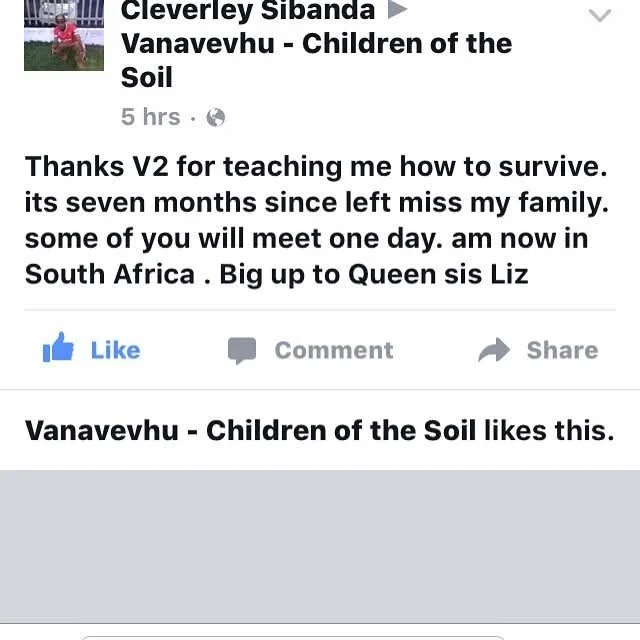
This truth settled in my spirit last year in Johannesburg.
After my MozFest talk, I met the Vanavevhu youth — the young people I once poured my life into, the ones I feared I had failed. They had crossed into South Africa in the aftermath of Zimbabwe’s collapse, living in various degrees of undocumentedness. For years, that reality lived in my body like grief.
We met at a fancy steakhouse. They arrived as parents, workers, survivors — young adults forging lives in a country that didn’t fully see them, yet couldn’t dim them. Their laughter filled the room. Their strength filled me. And I understood something I wish I had known earlier: the youth have never been the weakness. They have always been the miracle.

Judith: The Exception That Proves the Pattern
I thought about Judith, too, the Waterford Kamhlaba graduate whose brilliance lifted her out of rural Zimbabwe and eventually to Iowa, where I attended her college graduation last year. She had written me a message back then, so full of gratitude and sweetness that it stayed with me. But it was our call this morning that brought everything full circle. She told me she has secured a medical lab scientist position in Madison, starting in January — a step she carved out for herself through sheer discipline and talent.
Judith is extraordinary, but she should not have needed to be extraordinary to find a path out. Her journey exists because her academic gifts were undeniable enough for institutions outside Zimbabwe to intervene. But what of the millions of children whose gifts are quieter, slower, less easily noticed by systems that decide which lives deserve elevation? Judith made it out, not because Zimbabwe built structures strong enough to hold her, but because she had to leave.
That is the tragedy: our youth must become miracles just to access ordinary futures.
The Call Forward
If African governments continue to treat their youth as expendable, then the responsibility falls to those of us who know their worth — educators, organisers, fundraisers, social innovators, diaspora leaders, and communities who have always understood that children are sacred.
The future will not be built by those who see youth as collateral. It will be built by those who see them as sovereign.
And that is the work. That is the calling.
